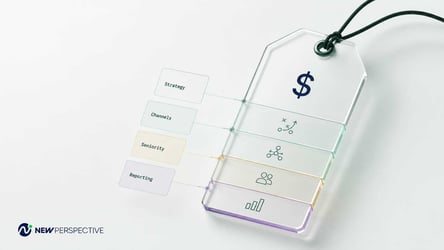

Three proposals for "a website redesign" land on the same desk: $12,000, $45,000 and $140,000. None of them is wrong. They are pricing three different projects and the reason website redesign cost is so hard to pin down is that most quotes describe only one of the three stacks you will actually pay for: the one-time build, the recurring platform and the line items that rarely make the proposal (content, migration, accessibility, integrations, maintenance).
This post gives you current numbers for all three, with the definitions behind them, a realistic timeline and a way to frame the total as payback rather than cost. It does not cover what the pages should contain; that is a separate post on manufacturing website design that wins RFQs.
Website redesign cost in 2026: the neutral ranges
Start with sources that do not sell web design.
| Source | Figure | Definition on the page |
|---|---|---|
| ClutchPage dated September 2026; aggregate of 79,260 listed agencies | Average project $38,105; most projects under $10,000; US agencies $100 to $149 per hour; average duration 7 months | All web design projects, all sizes |
| DesignRushDecember 2025 | Average $46,000; median $20,000 to $25,000; two-thirds under $25,000; mid-market $20,000 to $100,000 | Mid-market means multi-page builds, light integrations and design systems |
| HubSpot's cost guideJuly 2025 | Freelancer $2,000 to $15,000 at $25 to $49 per hour; agency $10,000 to $145,000 at $100 to $149 per hour; mid-size business $15,000 to $60,000; enterprise $50,000 and up | New builds; copy priced separately at $100 to $300 per page |
| UpworkNo date on page | Median $21 per hour; typical $15 to $30; full custom design $45 to $75 and up | Freelance hourly rates, no project scope |
The averages disagree because the samples do. Clutch's "most projects under $10,000" reflects the thousands of small sites in its sample; DesignRush's mid-market definition is the one that matches a B2B company with a sales team and it spans $20,000 to $100,000. If a quote lands outside that range, ask what makes the project larger or smaller than a multi-page build with light integrations. That question alone reconciles most of the spread.
Stack one: the build and what the ranges actually buy
Within the mid-market range, four things move the number: custom design versus a template system, page count and how many distinct page types need designing, how much of the content is written or rewritten and how many systems the site must talk to (CRM, marketing automation, product data, ERP). A 40-page site with three templates and a CRM connection is a different project from a 40-page site with twelve custom layouts and an ERP-fed product catalog, even though both are "40 pages."
Before you compare quotes, write the scope down in those four terms and send the same scope to every vendor. Our post on the 10 questions to ask before a redesign covers what to settle internally first. We publish how we think about agency pricing in B2B marketing agency pricing in 2026 and the same logic applies here: a fixed price for a fixed scope, with the scope written before the price.
Stack two: the platform, priced live
The build is one-time. The platform recurs and it is where 2026 quotes most often carry last year's numbers. These figures were read from the vendors' own pricing pages on September 1, 2026.
| Platform | Verified pricing | Notes |
|---|---|---|
| HubSpot Content Hub | Starter listed at $7 per seat per month beside $20 per seat per month; Professional $450 per month billed annually or $500 monthly, including 3 core seats (extra seats $45); Enterprise from $1,500 per month including 5 seats (extra seats $75) | No onboarding fee listed for Content Hub; the $7 Starter figure reads as promotional |
| WP Engine | Essential from $28 per month billed annually ($336 today); additional sites $20 per month | First-year pricing for new customers; Core and Enterprise plans are custom |
| Kinsta | Single site $35 per month or $30 on annual billing; WP 2 $70 or $59; WP 5 $115 or $96; Enterprise from $500 per month | Tiers scale with visits and site count |
| Webflow | Basic $15 per month billed yearly (static pages, no CMS); Premium $25 per month billed yearly (20,000 CMS items); Team platform $2,500 per month on an annual contract; full seats $39, limited seats $15 | Lineup changed in 2026; monthly-billing prices not verified here |
Model the platform over three years, not one. HubSpot Content Hub Professional on annual billing is $16,200 over three years before extra seats; a managed WordPress host at the entry tier is roughly $1,000 to $2,100 over the same period, before the plugins, security and developer time that a self-managed stack requires. Neither number is the "right" one. The point is that platform choice is a three-year decision that belongs in the redesign budget and if the plan includes moving platforms, so does the migration. We covered that path in our guide to migrating a website to HubSpot Content Hub.
Stack three: the line items quotes leave out
These are the items we most often see missing from a competing proposal, with the best neutral pricing signal available for each.
Content. The Editorial Freelancers Association's 2025 rate survey (1,100-plus respondents) puts business and marketing copywriting at 32 to 87.5 cents per word, or $65 to $75 per hour. HubSpot's guide prices it at $100 to $300 per page. A 40-page site with new copy is a five-figure line on its own and it is the line most often assumed to be "provided by client" and then never provided.
Photography and video. Stock imagery is why B2B sites look alike. Bark's commercial photography pricing guide puts professional photography at an average of $350 to $500 per day, with experienced independent photographers at $1,250 to $2,500 per day. One or two days on the plant floor is usually the best money in the budget.
Migration and redirects. Google's site move documentation (updated August 2026) is specific: use server-side permanent redirects, keep them in place for at least a year and expect temporary ranking fluctuation while it takes a few weeks for most pages to move. A redirect map for every URL that ranks or has backlinks is a deliverable and it should be priced.
Accessibility. WCAG 2.1 AA is the standard procurement teams increasingly expect from suppliers. The Department of Justice's Title II web rule applies to state and local government and its April 2026 interim final rule moved those deadlines to April 26, 2027 and April 26, 2028. Private B2B companies are not bound by Title II, but the litigation climate is real: UsableNet's 2025 year-end report reviewed more than 5,000 ADA-related digital accessibility lawsuits filed in federal and state courts, 70% of them against ecommerce sites. An audit and remediation pass is cheaper during a build than after a demand letter.
Integrations and year-one maintenance. No neutral source publishes reliable figures for these, so treat them as scope questions. Which systems connect, in which direction, with what ownership of the customer record? Who patches, backs up and updates the site after launch and what does that cost per month? A quote that is silent on both is not a complete quote.
Timeline: seven months is normal
Clutch's aggregate puts the average project at seven months. In our experience the calendar is set less by design and development than by content delivery and approvals, which is one more reason to price and schedule content as its own workstream. After launch, Google's own guidance implies several weeks of ranking movement while the new URLs are crawled and the redirects settle, so the measurement window for "did the redesign work" starts a quarter after go-live, not the week after.
What the number looks like against your budget
Gartner's 2026 CMO Spend Survey of 401 marketing leaders puts marketing budgets at 7.8% of company revenue in 2026, up from 7.7% in 2025. For a $50 million company that is a marketing budget of about $3.9 million a year and a $60,000 all-in redesign is roughly 1.5% of it. For manufacturers, whose marketing budgets we have benchmarked at 7 to 9.5% of revenue, the share lands in the same range.
Framed that way, the redesign is not the expensive line. The expensive line is three years of paid media and sales effort pointed at a site that cannot convert it.
Payback, not price
Here is the calculation we run with clients, with our assumptions stated so you can substitute yours. Take a $60,000 year-one all-in cost, a $50,000 average deal, a 25% close rate on qualified opportunities and a 30% gross margin. Each additional qualified opportunity the site produces per month is worth about $3,750 in contribution. One extra opportunity a month pays the redesign back in 16 months; two pays it back in eight; three in just over five.
Those opportunity numbers are the variable to argue about and they are the reason the redesign scope should be built around conversion rather than appearance. QiO's redesign doubled traffic and increased organic leads; Lambda Research modernized its web presence and CRM in one project. Both case studies carry the details.
Get a quote that itemizes all three stacks
Write the scope in four terms (design approach, page types, content, integrations), price the platform over three years, then insist every proposal shows content, redirects, accessibility, integrations and year-one maintenance as line items. The quote that itemizes them is usually not the cheapest and it is almost always the closest to what you will actually spend.
If you want a number for your own site built this way, book a Growth Marketing Session. We will scope the three stacks with you and you can see how we approach B2B website design and pricing before the call.