

Ask three agencies what demand generation costs and you will get three versions of "it depends." Here is a real answer instead. B2B marketing agency pricing for demand generation typically runs $2,500 to $15,000+ per month, and in complex B2B (manufacturing, energy, technical products, long sales cycles) most serious engagements land between $7,000 and $15,000.
Ours start at $7,000, and we publish that on our pricing page.
The rest of this post explains where those numbers come from, what moves them up or down, and how to tell whether a retainer is buying you pipeline or just activity.
Why Agencies Won’t Tell You the Price
Most agency pricing pages say "custom solutions" and offer a call. One 2026 pricing breakdown from Howl Marketing puts it plainly: "Almost nobody publishes a price. 'Custom solutions' and 'tailored packages' usually mean the agency wants to see your budget before naming one."
That opacity is a choice. Scope varies, but every agency knows its floor, its typical engagement size, and its ceiling.
Publishing a range costs nothing except unqualified calls. Which is the point: a stated price filters out mismatched buyers before anyone spends an hour discovering the mismatch.
The exceptions are worth noticing. In the complex-B2B specialist space, most of the serious players now publish real numbers, including firms we compete against directly.
When an agency names its price, you learn something useful about how it operates: it has a defined delivery model, and enough confidence in it to let you comparison-shop.
How Much Does a Marketing Agency Cost in 2026?
Here is the market, from published sources rather than a sales call.
Across B2B generally, retainers run $2,500 to $15,000 per month (Howl Marketing, 2026). Focused single-channel programs sit at the low end. Multi-channel demand generation runs $5,000 to $10,000.
Full go-to-market engagements reach $10,000 to $30,000 and up. If you are still scoping what sits inside those retainers, we broke down what a demand generation agency actually does separately.
Within the specialist field, here is what agencies publish today, ourselves and our competitors included. Every number below comes from the firm's own pricing page.
| Agency | Focus Sectors | Published Pricing |
|---|---|---|
| New Perspective (us) | Complex B2B: manufacturing, energy, agritech, SaaS | Starts at $7K/mo; most clients $7K-$15K/mo (pricing) |
| Weidert Group | Industrial marketing and sales | $15K-$30K/mo comprehensive programs; websites $50K-$100K+ |
| Gorilla 76 | Manufacturing specialist | $12K strategy Road Map to start; most full programs $200-250K/yr including media; consulting $4-5K/mo |
| Evenbound | HubSpot, RevOps, industrial B2B | Growth retainers $5K-$15K/mo; websites $30K-$50K |
| Kiwi Creative | B2B software and tech | $4,500 / $9,000 / $15,000/mo tiers; media billed direct |
Yes, several of those firms compete with us for the same clients. We link them anyway. A buyer comparing real numbers side by side is exactly the buyer we want to talk to, and the comparison holds up: senior-only delivery, sector depth, and a $7,000 starting point that sits below the comprehensive-program tier at the industrial specialists.
Not everyone plays. Larger shops often argue every engagement is too custom to price publicly. Maybe. But every agency knows its floor and its typical deal size, so treat "we can't say" as information.
Our own numbers in full: demand generation partnerships start at $7,000 per month, and most clients invest $7,000 to $15,000 depending on goals, channel mix, and pace. Website projects run $20,000 for a refresh to $40,000-$80,000+ for a full redesign.
Worth knowing what budget this sits inside. Gartner's 2026 CMO Spend Survey puts marketing budgets at 7.8% of company revenue, with paid media eating 31.4% of that budget, a five-year high. A $30M manufacturer at that benchmark has roughly $2.3M in total marketing budget. A $7,000 to $15,000 monthly retainer is 4 to 8 percent of it.
What Drives The Agency Price Up or Down
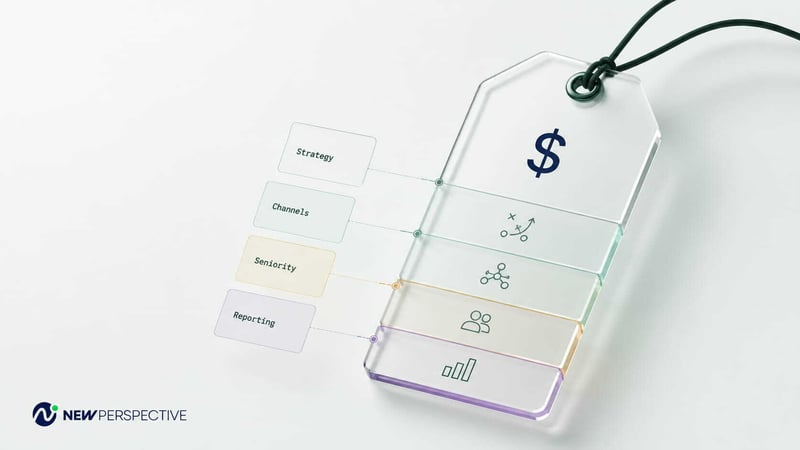
Four factors explain most of the variance in B2B marketing agency cost.
Scope and channel mix. Every added channel (paid search, LinkedIn, SEO, email nurture, ABM) adds strategy, production, and reporting hours. A one-channel program and a five-channel program are different products.
Seniority of the team. A retainer staffed by a senior strategist costs more per hour and less per outcome than one staffed by a coordinator with a checklist. This is where cheap retainers get expensive: you pay less monthly and spend the savings teaching the agency your market. We staff every engagement with people who have six-plus years of experience, which is part of why we do not compete at $3,000 a month.
Sales-cycle complexity. Demand generation for a 9-month, five-stakeholder industrial sale needs more content depth, longer nurture, and tighter sales alignment than lead gen for a self-serve SaaS product. That complexity is either priced in or skipped. You find out in month six which one you bought.
Pipeline goals and ad spend. Media management fees commonly run 10 to 20 percent of spend (Howl, 2026). More aggressive pipeline targets mean more spend, more campaigns, and more optimization hours.
Marketing Agency Pricing Models, and What Each One Rewards
The model matters as much as the number, because each model pays the agency to do something different.
-
Flat retainer ($2,500 to $15,000/mo) rewards retention: the agency keeps the fee by keeping you. Predictable, but scope discipline is on you.
-
Project fee ($5,000 to $50,000) rewards completion. Good for websites and one-time builds. Weak for ongoing pipeline work.
-
Hourly ($100 to $250) rewards hours. Almost nobody prices demand generation this way anymore.
-
Percentage of ad spend (10 to 20 percent) rewards higher spend. The incentive problem is built in: the agency's revenue grows when your media bill grows, whether or not pipeline follows.
-
Performance and hybrid models ($2,000 to $4,000 base plus $150 to $400 per qualified meeting) reward meeting volume, which only helps if the meetings are with your actual buyers. (Ranges: Howl Marketing's 2026 model comparison.)
None of these is wrong. But you should know which behavior your contract pays for, and whether that behavior is "build my pipeline" or something adjacent to it.
The In-House Comparison
The alternative to a retainer is a hire, so price the hire correctly. The U.S. Bureau of Labor Statistics puts the median marketing manager salary at $161,030 (May 2024 data). Benefits add roughly 30 percent on top of wages per BLS employer cost data.
So one senior in-house marketer costs around $210,000 fully loaded, about $17,500 a month, before tools, media, and ramp time. That is one person covering strategy, paid media, content, SEO, and reporting.
This is why the market is moving to the middle. Sagefrog's 2026 B2B Marketing Mix Report found the hybrid in-house plus agency model jumped from 36 percent to 46 percent in a year, now the most common structure in B2B, with 70 percent of B2B marketers increasing budgets in 2026.
The build-or-buy question is rarely either-or. We wrote a fuller comparison in agency vs. in-house marketing and a planning walkthrough in budgeting and strategic planning.
How To Tell If You're Overpaying
Overpaying is rarely about the number on the invoice. It is about what the number buys. The clearest tell is what your agency reports.
Most of the market still reports activity. 6sense's State of B2B Marketing Metrics found MQLs remain the dominant metric in demand generation while revenue outcomes like influenced pipeline and closed-won deals are tracked far less consistently.
Fewer than a quarter of marketing organizations report pipeline, opportunities, or revenue to their board. If your monthly report is impressions, clicks, and MQLs, you cannot know whether the retainer is working. Neither can the agency.
Buyers eventually notice. In Setup's Marketing Relationship Survey, dissatisfaction with delivery was the top reason clients fire agencies, at 48 percent and up 14 points year over year; 40 percent of clients said they planned to switch partners within six months. Gartner's 2025 survey found 39 percent of CMOs planned to cut agency budgets, led by "eliminating unproductive agency relationships." And choosing carefully beats re-pitching later: ANA and 4As research puts the client-side cost of an agency pitch at $408,500.
Five questions expose whether you are paying for activity or pipeline:
- "What pipeline did marketing influence last quarter, in dollars?" If the answer is MQL counts, that is an activity shop.
- "Who works on my account day to day, and how senior are they?" You are pricing the people, not the logo.
- "How is your fee structured, and what does it reward?" Percentage-of-spend and pay-per-meeting models optimize for things that are not pipeline.
- "What happens in the first 90 days?" A real answer includes measurement infrastructure, not just campaign launches.
- "What would make you tell us to spend less?" An agency accountable to pipeline has an answer. An agency accountable to activity does not.
Want a fast gut check on what your spend should be returning? Run your numbers through our marketing ROI calculator.
Where To Go From Here
If you are budgeting $7,000 to $15,000 a month for demand generation in a complex B2B market, you are in the realistic range. What decides whether it is money well spent is not the fee. It is whether the engagement is built to prove pipeline impact from day one.
That is the conversation we start with.
Book a Growth Marketing Session and we will walk through your goals, your internal capacity, and what a right-sized engagement would look like, numbers included.

 Kate Sears
 Jared Harris

 Nathan Harris