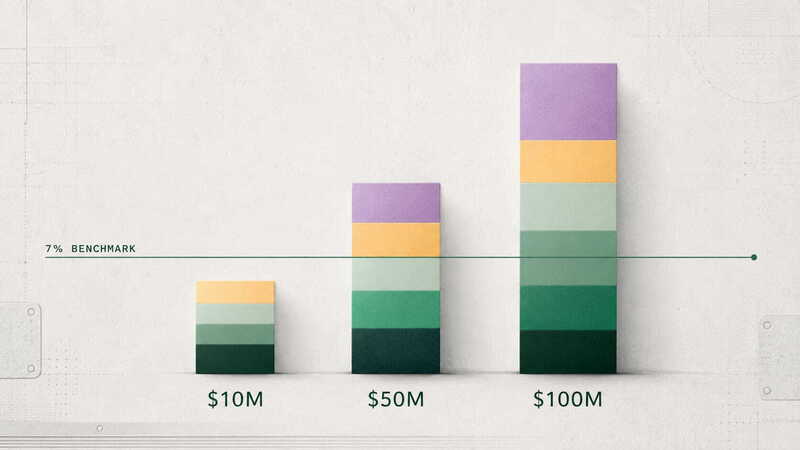

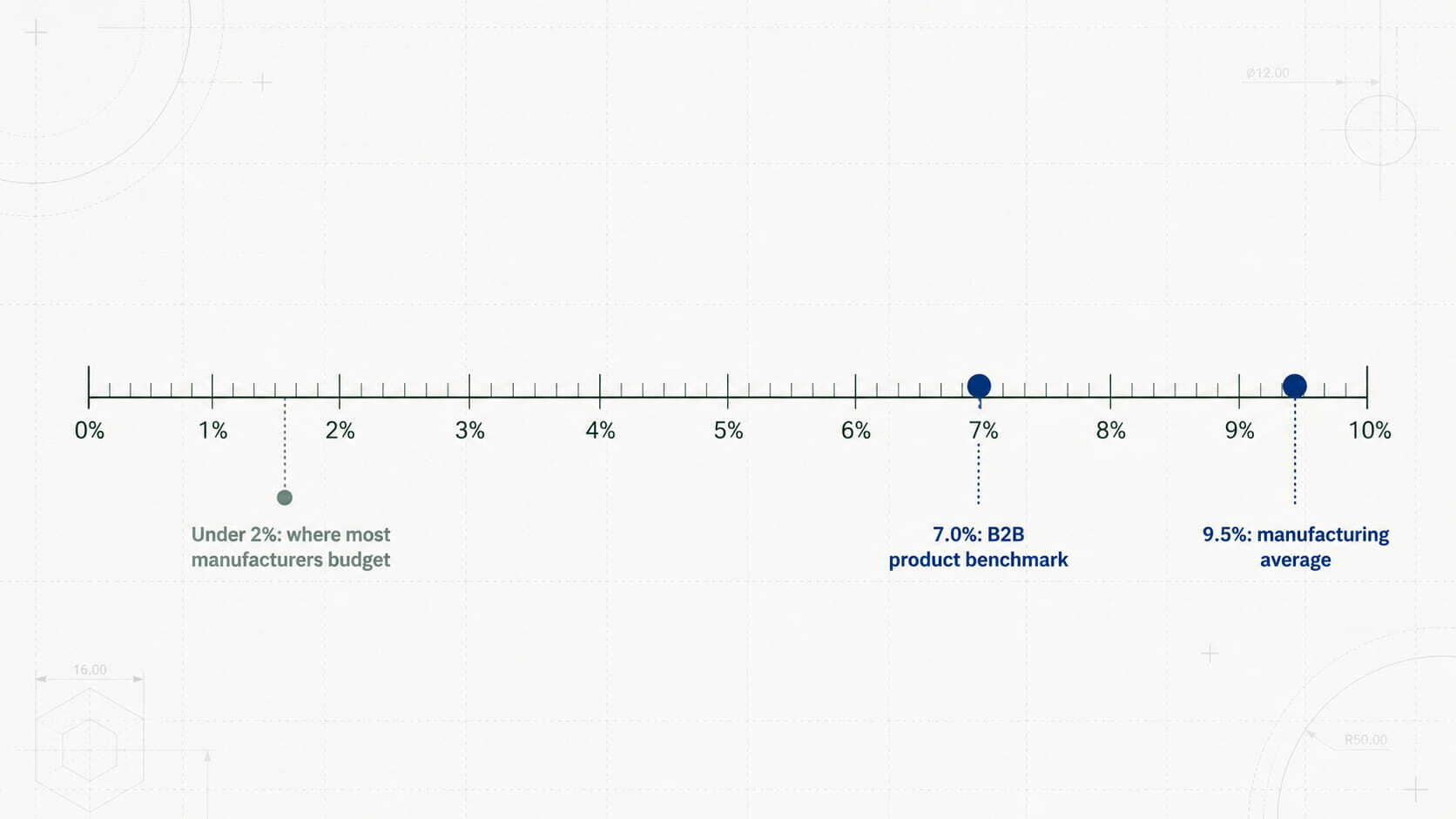
B2B product companies budget 7.0% of revenue for marketing, according to The CMO Survey's 2026 edition. Most manufacturers we talk to budget less than 2%, then conclude that marketing does not work in their industry.
The problem is rarely the channel. It is a B2B marketing budget sized for a world where the sales team did all the selling, applied to a market where 60% of the buying process now happens before anyone talks to a rep.
Below: the verified 2026 benchmarks, why underspending costs more than it saves, and what a right-sized budget actually buys at $10M, $50M, and $100M in revenue.
What the 2026 B2B Marketing Budget Benchmarks Say
Three credible data points define the current range.
The CMO Survey, run by Duke's Fuqua School of Business with Deloitte and the AMA, puts overall marketing budgets at 9.0% of company revenues in 2026. B2B product companies, the closest match for most manufacturers, sit at 7.0%. B2B services companies report 10.1%.
Gartner's 2026 CMO Spend Survey lands at 7.8% of company revenue, up slightly from 7.7% in 2025. One caveat before you quote it internally: Gartner's sample skews heavily toward companies above $1 billion in revenue. Enterprise budget behavior is not mid-market budget behavior.
The number that surprises manufacturing executives comes from Gartner's 2025 industry cut: manufacturing reported 9.5% of revenue, above the cross-industry average. The manufacturers who take marketing seriously are not spending less than everyone else. They are spending more.
Put those three numbers side by side and the range is 7% to 9.5% of revenue. A manufacturer budgeting 1-2% is not running lean; it is running at a quarter of measured norms, and pipeline tends to follow the same fraction. If your annual planning has never anchored marketing spend to revenue, our guide to marketing budgeting and strategic planning covers how to build that discipline.
Marketing Budget as a Percentage of Revenue: How to Read the Benchmarks
Benchmarks describe averages, not prescriptions. Reading them well means knowing what each one measures.
The CMO Survey is the better mid-market reference; its respondent base includes far more companies in the revenue range where most independent manufacturers live. Gartner is the better read on where large-company spending is heading. Both agree on direction: budgets tightened after 2023, and The CMO Survey notes overall marketing spending grew just 1.7% over the past 12 months, the weakest rate since 2021.
For manufacturers between $10M and $100M in revenue, we recommend planning between 3% and 7% of revenue. Where you land depends on one question: are you defending existing revenue or trying to grow it?
Maintenance supports the low end. A growth mandate, a new product line, or a new market pushes you toward the benchmark averages, because you are buying visibility you do not yet have.
Waiting for the market to force the issue is the expensive option. Forrester's 2026 budget planning data found 83% of B2B marketing decision-makers expect increased investment over the next 12 months. Your competitors are not cutting.
Why Manufacturers Underspend, Then Blame the Channel
The pattern is familiar. A manufacturer allocates a small budget, spends all of it on demand capture (a Google Ads campaign, a trade show booth, a website refresh), sees modest results, and concludes marketing does not work for complex industrial products. The conclusion is wrong because the budget never funded the part of marketing that does the heavy lifting.
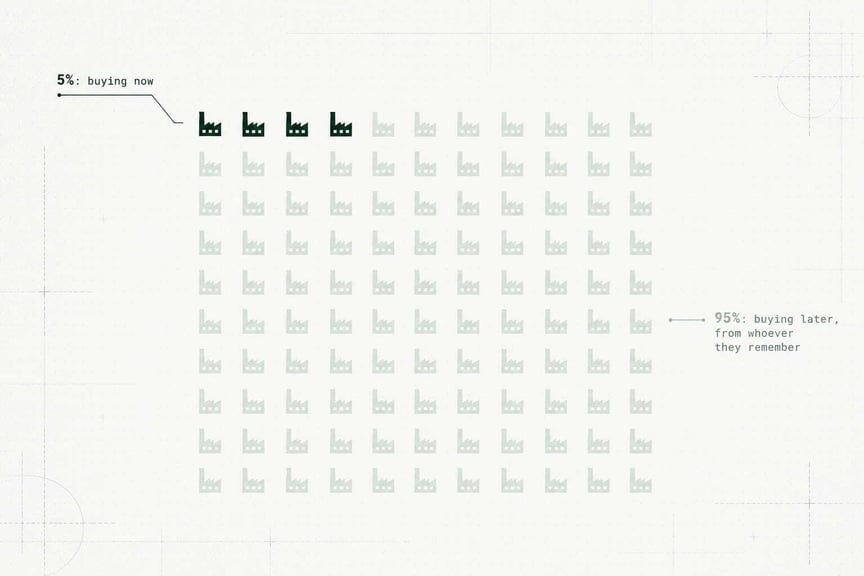
The Ehrenberg-Bass Institute's research for the LinkedIn B2B Institute found that up to 95% of business buyers are not in the market for your product at any given time. For capital equipment on a 6-to-18-month cycle, the in-market share in any quarter is a sliver. A budget that only funds demand capture competes for that sliver while ignoring the 95% who will buy eventually, from whichever supplier they already know.
The growth math runs the same direction. Binet and Field's analysis for the LinkedIn B2B Institute found that brands whose share of voice exceeds their share of market tend to grow: roughly 0.6 to 0.7 points of annual market share per 10 points of excess share of voice, with B2B responding almost identically to B2C. Spend below your market share for long enough and the mechanism runs in reverse.
Cutting deep has a measured cost too. Analytic Partners' ROI Genome analysis of the last recession found brands that slashed spend risked losing 15% of their business to competitors who increased theirs. Meanwhile 60% of brands that raised media investment saw ROI improve.
And the industrial buying process has moved to where marketing operates. GlobalSpec and TREW Marketing's 2025 State of Marketing to Engineers found 60% of the buying process happens online before engineers engage with sales, and 73% of technical buyers rely on vendor websites and online technical publications. Gartner's 2026 buyer survey found 67% of B2B buyers prefer a rep-free buying experience altogether. If marketing is underfunded, most of your buyer's journey happens where you are absent.
Manufacturing Marketing Budget Benchmarks by Revenue Tier
Percentages are abstract until you convert them into what they buy. Here is what right-sized looks like at three revenue levels. All three assume the same split of intent: enough demand capture to win the buyers searching now, enough demand generation to be remembered by the buyers who are not.
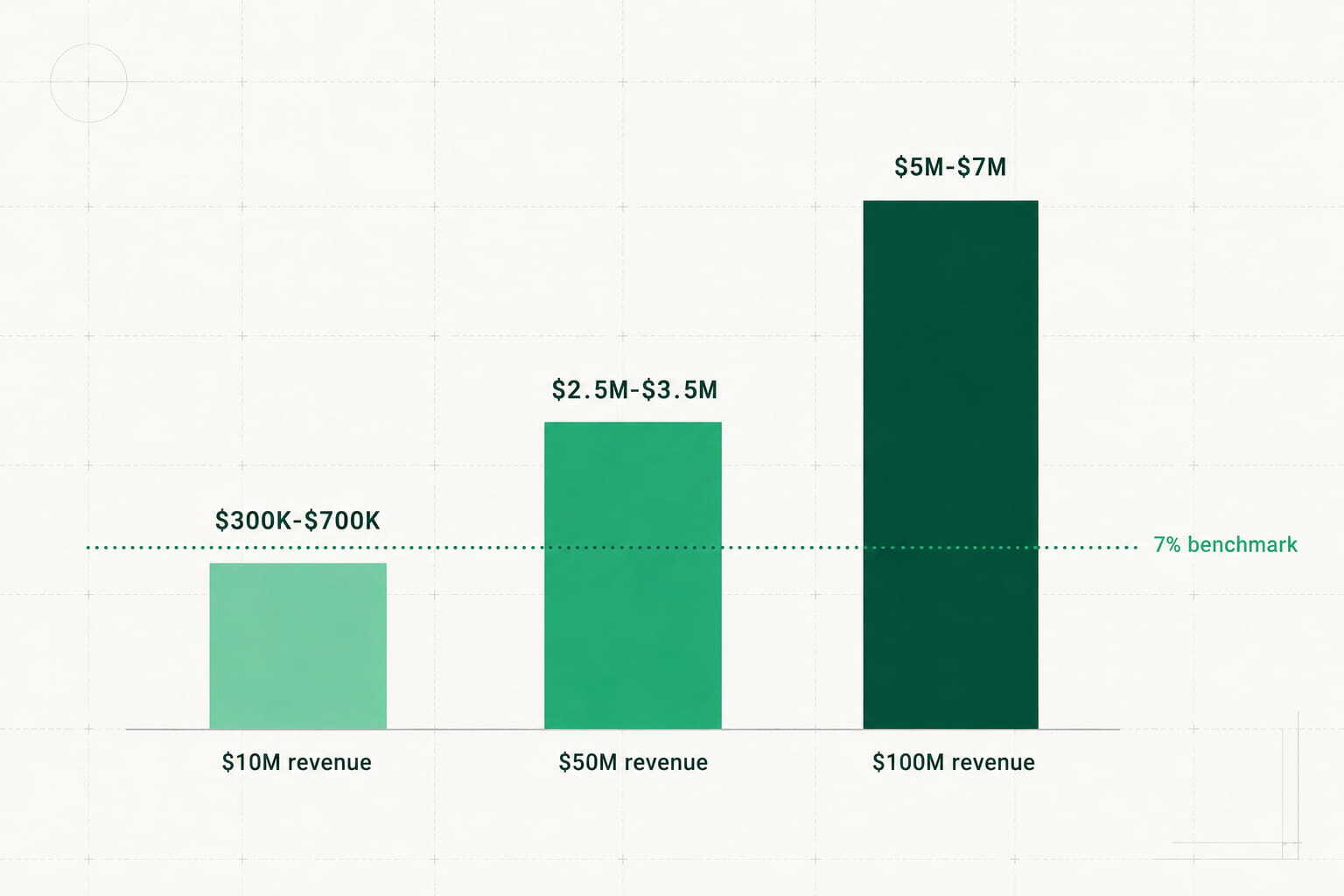
Marketing Budget for a $10M Manufacturer: $300K to $700K
At $10M in revenue, 3% is $300K and 7% is $700K. That sounds like a lot until you price the components.
One experienced marketing hire consumes a third of the low end before benefits: the BLS median salary for marketing managers was $161,030 in May 2024, and $168,210 in manufacturing specifically. This is why most manufacturers at this size pair one internal coordinator with outside senior help instead of building a team. We compared the math in marketing agency versus in-house, and our pricing page shows what an engagement costs, so you can run the numbers yourself.
Paid media at this tier is real but modest. LocaliQ's 2026 search advertising benchmarks put the Industrial and Commercial category at $5.87 per click and $75.19 per lead. A $60K annual search budget, managed well against specification-stage keywords, generates consistent inbound inquiries. It does not also fund LinkedIn, retargeting, and three trade shows.
A working budget at this tier covers: one internal marketing owner, an agency or fractional team for strategy and execution, a website that supports technical evaluation, a focused paid search program, and one or two trade shows chosen for buyer fit rather than habit.
What a $100K budget buys at this revenue level is a brochure website and a disappointing year. That is the underspend trap: visible enough on the P&L to attract scrutiny, too small to produce the outcome that would justify it.
Marketing Budget for a $50M Manufacturer: $2.5M to $3.5M
At $50M, 5% to 7% of revenue puts the budget between $2.5M and $3.5M. The question changes from "what can we afford" to "what mix compounds."
This is the tier where the trade show line deserves scrutiny. CEIR's 2026 Marketing Spend Decision Report found B2B exhibiting still takes 40.8% of exhibitor marketing budgets, the largest single channel. Hold that against the GlobalSpec finding that 60% of the buying process is over before sales contact, and the mismatch is hard to unsee: many manufacturers put the plurality of their budget into the last stage of a journey that is mostly decided earlier.
The answer is not abandoning shows; 75% of engineers planned to attend at least one in-person event in 2025. The answer is integration, so the buyers who meet you at the booth already know who you are. We cover the mechanics in how to get more ROI from trade shows.
A right-sized budget here funds a small internal team, an agency relationship for strategy and channel depth, always-on demand capture (search, retargeting, a tested LinkedIn program), a content engine built for engineers and specifiers, a rationalized show calendar, and the measurement infrastructure to see which of those produces pipeline. Want to pressure-test the return math first? Our marketing ROI calculator exists for exactly that conversation.
Marketing Budget for a $100M Manufacturer: $5M to $7M
At $100M, 5% to 7% is $5M to $7M, and the binding constraint usually stops being money. It becomes structure and measurement.
Binet and Field's B2B research points to roughly a 50/50 split between brand building and sales activation as the effectiveness optimum. Most industrial budgets we see at this size run closer to 90/10 in favor of activation. Rebalancing does not mean brand campaigns for their own sake; it means sustained visibility in the channels your buying committee uses between purchase cycles.
Allocation discipline matters more here because the dollars are large. In Gartner's 2025 CMO Spend Survey, paid media accounted for 30.6% of marketing budgets, the largest line. At $6M of spend, that is $1.8M of media that needs attribution good enough to defend in a board meeting.
The buying committee is the other structural fact. Manufacturing deals typically involve three to six stakeholders: an engineering lead, an operations leader, procurement, and a senior approver. Each needs different content at different stages, which is why content and sales enablement is a first-class budget line at this tier, not an afterthought. This is the work we do inside industrial manufacturing marketing engagements: connecting the spend, the system, and the reporting so the CFO can see what the budget produced.
B2B Marketing Budget Allocation: Where the Money Should Go
Whatever your tier, the allocation logic holds. Fund demand capture first, because in-market buyers are the fastest revenue: search, your website's conversion paths, and the shows where your buyers actually walk the floor. Then fund demand generation with what remains, consistently, in fewer channels rather than thinly across many.
Consistency is the variable underspenders get wrong. Presence that flickers on and off buys almost nothing.
Reserve a real line for measurement. Attribution, CRM lifecycle structure, and pipeline reporting are what turn next year's budget conversation from an argument into a review.
How to Defend Your Industrial Marketing Budget to the CFO
CFOs do not reject marketing budgets; they reject unanchored ones. Three moves change the conversation.
Anchor to the benchmark. "We are proposing 5% of revenue against a B2B product benchmark of 7%" is a defensible sentence. It reframes the proposal from a cost into a below-market investment.
Anchor to the buyer. Your CFO may still picture marketing as air cover for a sales-led process. The verified numbers say otherwise: 60% of the buying process is over before sales is in the room, and 67% of buyers would prefer to skip the rep entirely. Underfunding marketing now means being invisible for most of the purchase decision.
Anchor to pipeline. Commit to reporting marketing's contribution in pipeline terms, not activity terms. The budget that survives scrutiny is the one attached to a number the CFO already cares about.
If the budget is genuinely capped below benchmark, cut channels, not consistency. A focused $400K program in two channels beats $700K scattered across six.
The benchmark data points one direction: manufacturers who fund marketing at market rates are buying shares from the ones who do not. The only open question is which side of that trade you are on.
Bring your revenue figure and growth target to a Growth Marketing Session and we will map what a right-sized budget looks like against your pipeline goals.

 Nathan Harris

 Jared Harris