
Key takeaways
- Why AI product mentions don't guarantee accurate product information
- Which product claims manufacturers should verify in AI search
- How to check AI answers against technical documents and cited sources
- What to correct on product pages, specification sheets, and distributor listings
- How to track errors and measure changes in AI answers over time
On this page
Suppose an AI answer recommends your indoor sensor for an outdoor installation. It names the correct model but contradicts the installation guide. An AI search audit should catch that error.
For manufacturers and industrial suppliers, we recommend checking the claims buyers use to select a product: model details, application fit, operating limits and certification scope. A product mention on its own says nothing about whether those details are correct.
Include this review in your AI search readiness work. The first pass can cover just two products, as long as you have current evidence to check the answers.
Confirm the Specifications for Each Product Model
Pick products your team knows well. A recently revised model or a family with similar names gives you specific details to test, such as whether an answer confuses one version with another.
Sales should supply questions buyers ask when comparing models or specifying equipment. Engineering or the product owner should confirm the technical answers. Marketing can coordinate the review and follow up on corrections.
Before testing, agree on the documents you'll use as references. They need to cover the exact model, configuration, intended use, operating limits, compatibility and certification scope. Include the market or region wherever it changes the answer.
If the product page and installation guide disagree, resolve that with the product owner first. Otherwise, you're judging an AI answer against information your own team hasn't settled. Record the versions and review dates of the documents you approve.

Check the exact model and configuration against its own documentation.
Use Industrial Buyer Questions in Your AI Search Audit
Write four questions for each product, using the model name and any conditions a buyer would need to specify.
|
Buyer Decision |
Question to Test |
|---|---|
|
Product purpose |
What is [model] from [manufacturer] designed to do? |
|
Application fit |
Can [model] be used for [application], and what operating limits apply? |
|
Compatibility |
Is [model and configuration] compatible with [system]? |
|
Certification |
Which certifications apply to [model and configuration] in [market]? |
Run each question twice in two named AI search modes. With two products, that gives you 32 recorded runs. That gives you a first set of results to inspect. It won't tell you how often buyers receive an error.
Save the exact prompt, full response and source links for every run. Include the date, displayed model or mode, language and whether web search was used. Keep the question wording unchanged between repeats, and record when no AI answer appears.
For chat tools, use a fresh conversation each time. That doesn't necessarily remove saved memory: OpenAI explains that memory and location can affect ChatGPT search queries. Note those settings and keep account and location conditions consistent where possible.
Results also need to stay separated by mode. Google says AI Mode and AI Overviews can use different models and methods, which can produce different responses and links.
Save the first answer before supplying a document or pointing out a mistake. Once you provide the evidence, you're testing how the tool responds to that evidence. You've changed the question you're investigating.
Check the Claims Separately From the Citations
An answer can name the correct model, miss an operating limit and overstate its certification. Reviewing the whole response as a single item would hide those differences.
Give each claim that affects product selection its own spreadsheet row. Include the exact wording, a link to the saved response and the current evidence used to check it. The technical reviewer can then assess it against these definitions.
|
Assessment |
When to Use It |
|---|---|
|
Supported |
Current evidence supports the claim for the exact model, configuration and conditions |
|
Contradicted |
Current evidence conflicts with the claim |
|
Outdated |
The claim matches identifiable older or superseded information |
|
Missing Context |
The answer omits a necessary condition, configuration or limit |
|
Not Verifiable |
Available evidence cannot confirm or reject the claim |
“Outdated” needs evidence too. If you can't trace an incorrect specification to an older document, don't assume that's where it came from.
The citation gets a separate check: Supports the Claim, Does Not Support the Claim, No Citation or Cannot Check. Open the source and find the passage that supports the statement. A real certificate may apply to only one configuration, even if the AI answer makes a broader claim.
In that case, record the missing condition. The link's existence doesn't resolve the error.
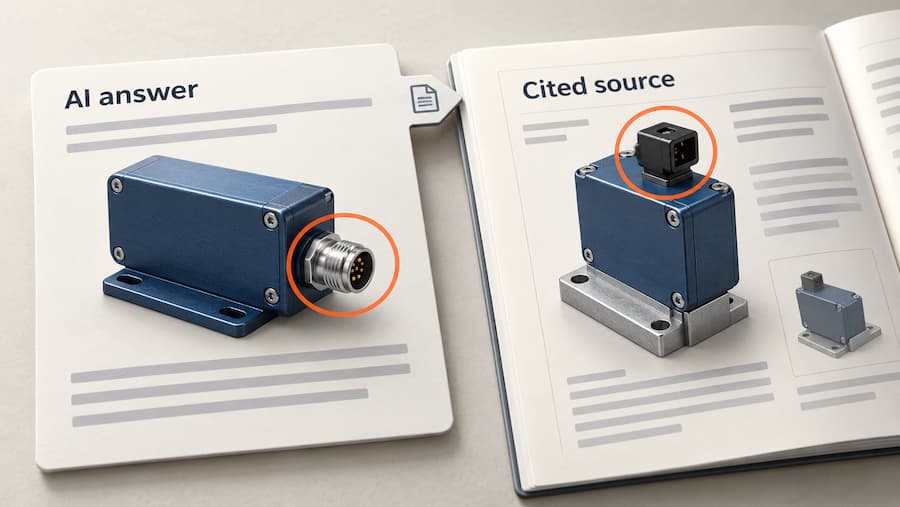
A cited document must support the specific model, configuration and claim.
Keep unanswered questions separate from false claims. OpenAI's research on hallucinations distinguishes errors from abstentions. A refusal, an absent AI answer or a response that doesn't mention your product isn't itself an incorrect product statement.
Correct Product Pages and Distributor Listings
Deal first with errors that could change product selection: unsuitable applications, unsupported compatibility, missing operating limits or incorrect certification scope.
Before assigning a website change, inspect the source. The answer may have repeated an old listing, misread an accurate document or supplied a claim without a source you can check.
If your current documentation is correct and clear, don't change it to match an AI response. Record the answer error and recheck it.
When the review does expose a content problem, the action should be specific:
- Name the model and configuration on the relevant product page.
- Add missing application limits to product FAQs or application notes.
- Update the current specification sheet and clearly label historical versions.
- Ask distributors or directory owners to correct outdated listings.

Check product pages, current documents and distributor listings against the same approved facts.
For the hypothetical indoor sensor, a missing installation limit on the product page would justify an edit. If an old listing still presents a discontinued model as available, ask its owner to correct the status.
Our guide to manufacturing pages to review for AI search can help you choose which pages to inspect. Product pages, FAQs and supporting documents should give buyers consistent answers.
A correct document also needs to be reachable. When search systems can't access it, check crawler access before commissioning more copy. Where rewriting is needed, technical review belongs in the content and messaging work. The revised page still needs to preserve every relevant condition.
After updating a page you manage, you can ask Google to recrawl the URL. Google says crawling can take days to weeks, with no guarantee of inclusion. That gives you no deadline for an AI answer to change.
Recheck the Answers and Report the Remaining Problems
The audit should leave you with confirmed product facts, source corrections assigned to named owners and a list of answer errors that remain unresolved. Give each action a review date. Keep the approved evidence, source edit and recheck result together.
Then repeat the original questions under comparable settings. Note any platform or model changes that could affect the comparison.
Count runs containing contradicted or outdated claims. Track missing context, unverifiable claims and unanswered questions separately. A run counts once within each category, though it may appear in more than one.
For example, if three of 32 runs contain a contradicted claim, report “3 of 32 runs.” Show the count and denominator for each mode too. That number describes your sample.
Claim counts tell you something different. One response with four incorrect claims is one affected run and four incorrect claims.
If an answer changes after an edit, record the difference. The timing alone doesn't show that your edit caused it or that future responses will stay correct.
Use the results alongside your AI citation measurements. You can then see where products appear and whether the answers describe them accurately.
Product Accuracy Checklist for Manufacturers
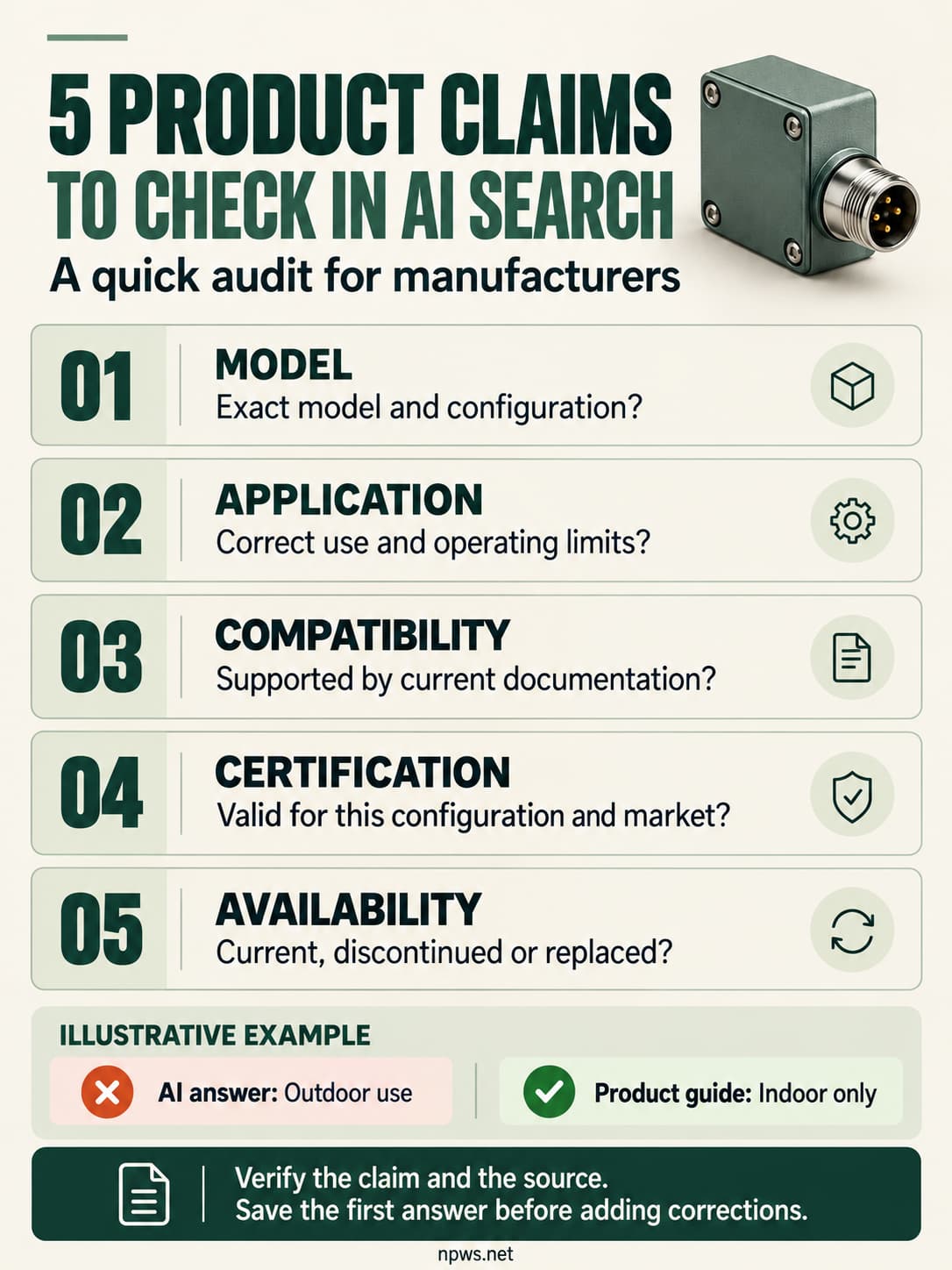 Save this checklist to review AI product claims against current documentation.
Get Help Reviewing Your Product Information
Wrong model details, conflicting documents and missing application limits give your team specific problems to address. Our SEO and AI search services cover the technical search, content and measurement work involved.
Bring those problems to a Growth Marketing Session. We'll discuss what your team can correct and what needs further investigation.