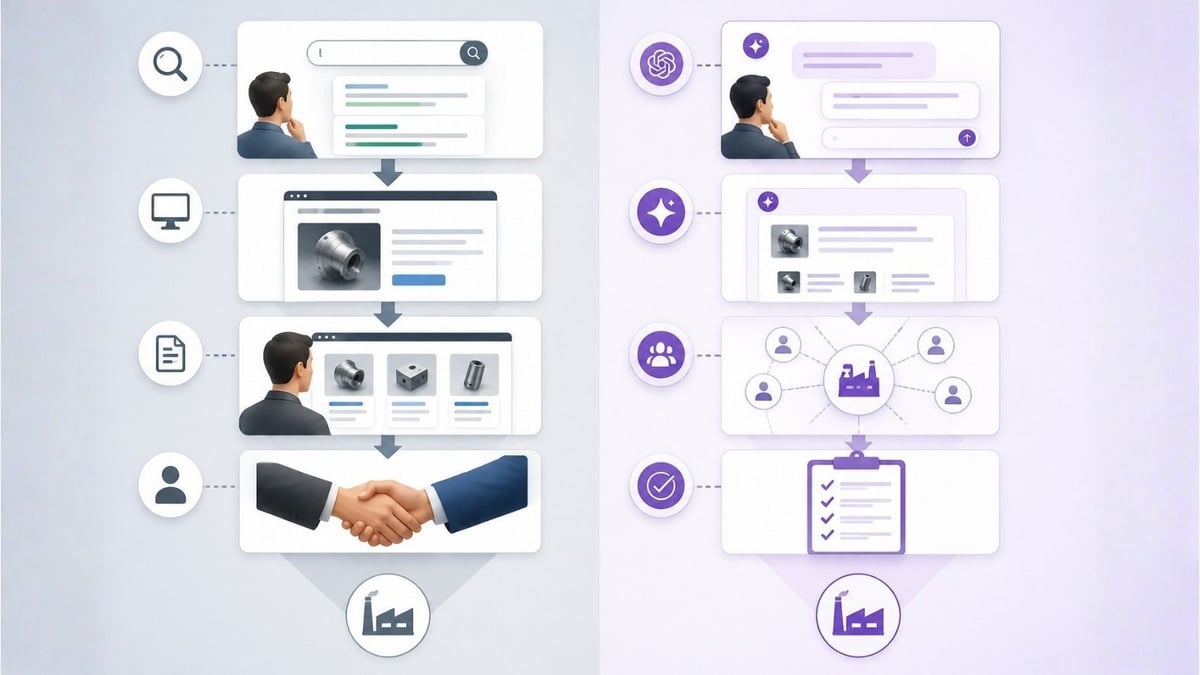
Open ChatGPT and ask it to recommend a supplier in your category. Then ask Perplexity. Then check Google's AI Overview. One of three things happens: a competitor gets named, a directory you are not listed in gets cited, or your company does not come up at all.
For a growing share of your buyers, that answer is the shortlist. It formed before anyone visited your website, talked to your sales team, or filled out a form.
Most manufacturing marketers treat AI citation as a black box. It is not. Getting named in an AI answer is mechanical: the predictable output of a handful of signals you can check, benchmark against competitors, and fix in a deliberate order.
This post explains the research behind those signals, then hands you a two-minute readiness check that scores your company against all of them, right on this page. Think of it as AI search optimization for manufacturers, minus the jargon.
The shortlist now forms before you know the deal exists
The old model was visible. A buyer searched Google, clicked a few links, read your site, and showed up in your analytics. You could see most of the journey and optimize every step of it.
That top of funnel is moving into a chatbot you cannot see.
The clearest public evidence comes from software buyers, so read it as a leading indicator rather than gospel. In G2's 2026 study of more than 1,000 B2B buyers, 71% now use AI chatbots in their vendor research, 69% said AI guidance led them to a different vendor than they originally planned, and roughly one in three bought from a company they had never heard of before a chatbot named it.
Procurement data points the same direction. A UK study summarized by Trax found 66% of senior B2B decision-makers using AI tools to research suppliers, and 90% of them said they trust the recommendations.
The methodology there is thinner than G2's, so hold the exact figures loosely. The direction is hard to argue with, and it matches the broader shift in how B2B buyers discover vendors that has been building for years.
Now layer in how manufacturing actually buys. Gartner pegs the typical complex B2B buying group at six to ten stakeholders, each bringing four or five pieces of independently gathered research.
Forrester estimates roughly 61% of the buying journey is complete before a vendor is ever contacted. So this is not one buyer running one query. It is a design engineer, a plant lead, and a procurement contact each running their own AI searches, on their own time, building a case you never see.
If you are not in those answers, you are not losing the deal. You were never in it.
AI search optimization for manufacturers is mechanical, not magic
Stop thinking about citation as the model "liking" a competitor more. Think about what an answer engine needs before it can safely quote a source.
The most rigorous research here is the Princeton GEO study, published at ACM SIGKDD 2024. The team ran 10,000 queries through a generative engine and tested which content changes actually moved a page's visibility inside the answer.
Three did the heavy lifting: adding specific statistics, citing named sources, and including direct quotes. Each improved visibility by up to 40% in their tests. Keyword stuffing, the move that defined a decade of bad SEO, did essentially nothing.
That is the whole game. The page that wins is not the one that repeats the keyword most. It is the one that is easiest to quote with confidence.
Authority compounds the effect. Ahrefs found that roughly 65% of ChatGPT's most-cited pages sit on high-authority domains (DR 80+). In practice, answer engines lean heavily on third-party sources: trade publications, directories, reviews, distributor and partner pages. The wider web's opinion of you weighs as much as anything on your own site. Your website is necessary. It is not sufficient.
One honest caveat, because vague confidence is exactly what AI penalizes and exactly what we are telling you to cut. Citation is not the same as ranking. AI Overviews regularly cite pages that never appear on the first page of traditional results. You can rank well and still get skipped, or get quoted from a page that ranks nowhere. Unsettling, and also the opening: the rules for getting quoted are not the rules you spent ten years optimizing for.
None of this requires exotic tooling. Google's own position is that optimizing for its AI features is still SEO: indexable pages, expert content, clear structure. The inputs are familiar. What you measure at the end has changed.
Check your AI search readiness in two minutes
Here is the part you can use right now, on this page.
The check below asks ten questions. Each one maps to a signal the research says decides whether an answer engine can find you, read you, and name you with confidence: whether AI tools can crawl your site at all, whether your product detail is structured for machines and not just people, whether your best content sits in the open or behind a form, whether you use your buyers' language, whether anyone has ever actually checked what AI says about your category, and whether you can tie any of it to pipeline.
Answer yes, no, or not sure. Two minutes, no email required to see your score. Be honest, and count "not sure" as what it usually is: a no that nobody has checked yet.
Your result lands in one of three tiers.
Mostly Ready. You are ahead of most manufacturers, which raises the bar rather than lowering it. The edge now lives in specifics: which exact queries your buyers run, which competitors are present where you are not, and which pages return the most citations for the least work.
Partially Visible. You show up sometimes, which means you are handing citations to competitors who closed the gaps you have not. The difference is rarely the product. It is whether the machine can read the page and trust what it finds.
Largely Invisible. Most of your buyers' AI research is happening without you in the answer. The good news: the technical gaps are the fastest to close, and the breakdown under your score shows exactly which ones are yours.
Whatever your tier, the gap breakdown matters more than the number. It is the difference between knowing you are behind and knowing what to build.
Your ideal buyers are searching. If you're not showing up, especially in AI results, you're out of the running. We help you get found, get chosen, and turn search into revenue. See how our SEO work covers AI search.
Go deeper than the score: run your own citation audit
The readiness check tells you whether your house is in order. It cannot tell you what AI engines are actually saying about your category today. For that, you need an hour and a spreadsheet.
Build a short query list first, phrased the way your buyers actually phrase things. Category prompts ("best suppliers for X"), comparison prompts ("A vs B for Y application"), requirement prompts ("what to look for when sourcing Z"), and compliance or maintenance prompts. Aim for ten to fifteen.
Run every prompt across ChatGPT, Perplexity, and Google AI Overviews. For each one, record three things: who got named, which URLs got cited, and whether you appeared at all. ChatGPT's sources panel and Google's inline links make this faster than it was even a year ago.
Patterns surface quickly. A trade directory you are not listed in gets cited in half your prompts. One competitor owns every comparison query. Your own pages get cited for the easy questions and vanish on the technical, high-intent ones, which is the worst place to lose.
Now map each finding back to the readiness check. Absent from comparison queries: usually structured content plus third-party authority. Named inconsistently or not at all: the machine cannot tell who you are. Cited, but only for thin pages: your high-intent pages lack the specifics that get quoted. The diagnosis tells you what to build, not just that you are behind.
This is the manual version of what a full audit does at scale across your entire buying committee. The manual version is enough to stop guessing.
What to fix first
Do not try to win every dimension at once. Sequence by effort against payoff.
Fast wins, this quarter. If the check flagged crawler access or machine readability, fix those first; nothing else matters while AI cannot read your site. Then clean up how you are described across your site, LinkedIn, and the major directories so you are one consistent entity everywhere. Then take your five highest-intent pages and add proof: real numbers, named results, spec detail, a credible citation or two of your own. These are edits, not projects, and they hit the signals the GEO research rewards most.
Compounding work, start now. Earned authority in trade press, distributor and partner pages, the industrial equivalent of a review layer. And the structured technical content that directly answers specification-stage questions. None of it lands overnight. It is the difference between being citable in six months and still being invisible.
Two things to keep straight. First, this runs alongside your SEO, not instead of it. Pages still have to be indexable and worth ranking; AI visibility sits on top of that foundation. Second, remember who is actually asking. Coverage does not mean winning one query. It means being the defensible answer when the technical evaluator asks their question and when the economic buyer asks theirs. In manufacturing those are different people with different prompts, and you need to show up for both.
The manufacturers getting cited are not smarter about AI. They are easier to quote: clear about who they are, specific about what they do, and backed by a web that agrees. That is not a trick. It is a standard you can hold yourself to, starting with a score.
Take the two-minute check above if you have not already. If you would rather see your real coverage across the full buying committee, not just one self-assessment, book an exploratory call and we will audit where you actually stand before we talk about anything else.