
LLM SEO is the work of making your company the source AI systems cite when your buyers ask their questions. It covers Google's AI Overviews, ChatGPT, Perplexity, Gemini and the assistants your prospects use before they ever reach your site. It builds on the same foundations as search engine optimization. It does not replace them.
That last sentence is the thesis of this post, because most of what you have read about LLM SEO says the opposite. The pitch usually runs: search is dying, everything you built is obsolete, buy the new thing. The data and our client results say something more useful.
The brands getting cited in AI answers are mostly the ones whose SEO fundamentals were already sound, with a specific layer of structural work added on top. This post explains that layer, shows it working for a manufacturing client and gives you a way to measure whether it is working for you.
What is LLM SEO and how does it relate to AEO and GEO?
The industry has not settled on one name. LLM SEO, answer engine optimization (AEO), generative engine optimization (GEO) and AI search optimization describe overlapping work: getting your content selected, quoted and linked by systems that generate answers instead of listing pages.
The differences are mostly emphasis. AEO grew out of featured-snippet work and leans toward Google's AI Overviews. GEO tends to mean visibility inside chat products like ChatGPT, Grok and Perplexity. LLM SEO is the broadest label, covering both. We are not going to litigate the vocabulary; pick a term and do the work, because the work is nearly identical under every name.
Is the shift real, or is this another hype cycle?
Real and measurable from independent sources, not just vendors selling tools.
Pew Research Center tracked 900 US adults through 68,879 real searches and found that when an AI summary appeared, users clicked a traditional result on 8% of visits, versus 15% without one. Ahrefs measured the same effect from the publisher's side: the presence of an AI Overview correlated with a 34.5% lower click-through rate for the top-ranking page. And by early 2026, Similarweb clickstream data had 68% of US Google searches ending without any click at all.
The traffic that does arrive from AI surfaces behaves differently. Adobe's analysis of more than a trillion visits found generative AI referral traffic grew more than 10x between July 2024 and Feb 2025, with AI-referred visitors bouncing less, staying longer and closing most of the conversion gap with traditional channels.
Fewer clicks, better clicks and a new surface deciding who gets them. That is not a hype cycle. That is a channel shift with a measurement problem, which is exactly the kind of thing a marketing leader can work with.
How do AI systems choose their sources?
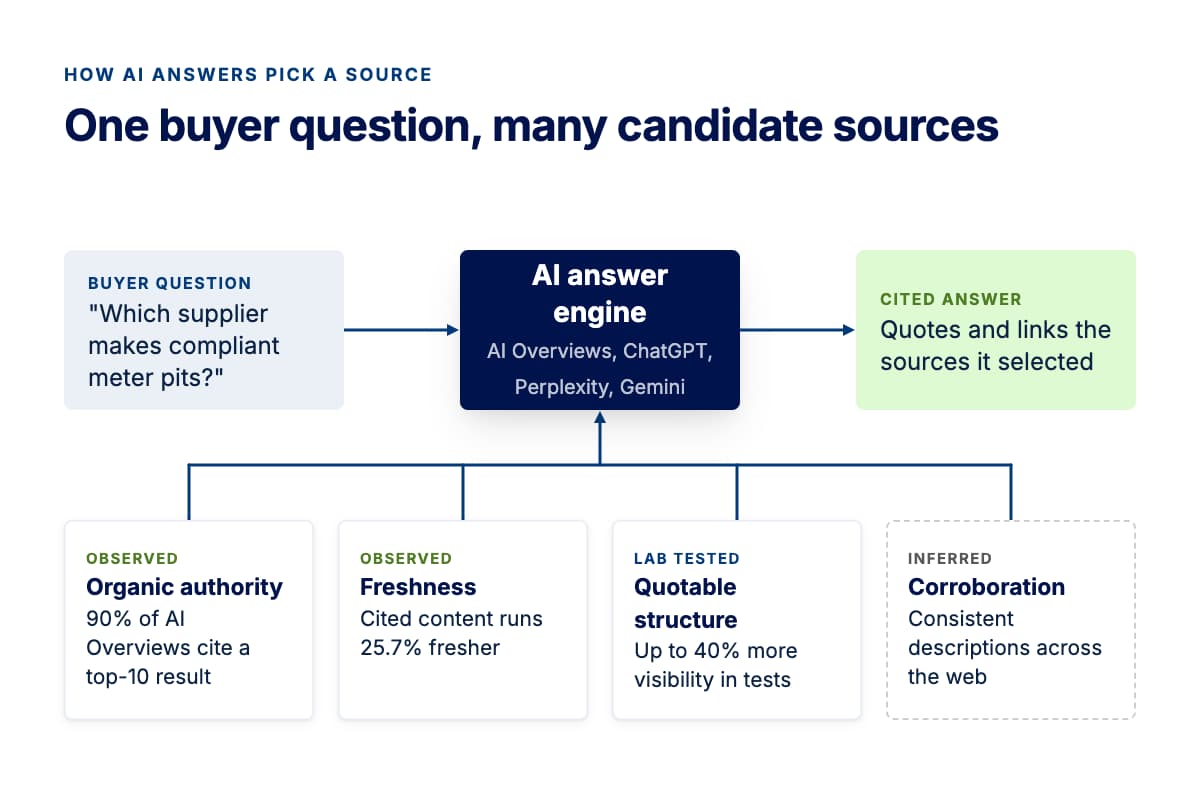
Nobody outside these companies knows the full selection logic and anyone who claims otherwise is selling something. Here is what the evidence supports as of September 2026, split into what is observed and what we infer.
Observed, with data behind it. Google's AI Overviews still lean heavily on strong organic results: seoClarity found 90% of AI Overviews include at least one URL from the top 10 organic results. Chat assistants roam much wider: Ahrefs found only 12% of URLs cited by AI assistants rank in Google's top 10 for the query and roughly 80% don't rank in the top 100 at all. Freshness matters more than it did: Ahrefs' citation data shows AI platforms favor content 25.7% fresher on average than what traditional results serve and 76.4% of ChatGPT's most-cited pages were updated within the previous 30 days.
Structure matters too and here the evidence is experimental. The academic GEO research presented at KDD 2024 tested content changes across 10,000 queries and found that adding quotations, statistics and cited sources lifted visibility in generative answers by up to 40% in benchmark conditions, while keyword stuffing scored below doing nothing. A lab benchmark is not the live web, but the direction is consistent with what we see in client work: systems quote passages that stand alone, such as a clean definition, a specific number with context or a clearly stated recommendation.
Inferred, labeled as inferred. Entity clarity appears to matter: the system needs to resolve exactly who you are, what you make and for whom. Corroboration appears to matter: brands described consistently across their own site, directories and third-party coverage seem to get picked over brands the model has to reconcile. We treat both as working hypotheses, not facts.
Does schema markup get you cited in AI answers?
This deserves its own section, because it is where most LLM SEO advice is now out of date.
Google's official documentation is blunt: there are no additional requirements to appear in AI Overviews or AI Mode, no special files, no special markup and no AI-specific schema. And in May 2026, Ahrefs ran the controlled test: 1,885 pages that added JSON-LD schema, tracked against 4,000 matched control pages. The result: no statistically significant citation lift on AI Mode, ChatGPT or AI Overviews.
So we position schema where the evidence puts it: hygiene that helps machines parse your entities and powers other search features, not a lever that buys citations. If a vendor's LLM SEO pitch leads with schema, ask what else is in the plan.
What changes in the work and what doesn't
The foundations do not change. Technical health, crawlability, site speed, topical authority and earned links still decide whether you are in the candidate pool at all. If your site was not competitive in traditional search, no AI-specific tactic rescues it; and if AI crawlers are blocked from your site, nothing downstream matters. This is why we run LLM SEO inside our SEO and AEO services rather than selling it as a separate product.
What changes is the shape of the content. Four adjustments carry most of the weight:
- Answer blocks. Every important page opens with a direct answer under 60 words. State the thing, then earn it. Pages that build to a reveal never get quoted, because the quotable sentence is buried in paragraph nine.
- Question-shaped structure. Headings phrased the way buyers ask, with one clean answer per section. This is also how People Also Ask boxes and chat follow-ups get sourced.
- Citable specifics. Numbers with context, named methods, dated claims. "We route quote requests to reps by territory" can be cited. "We optimize your funnel" cannot. This is the GEO paper's finding applied to your pages.
- Consistency and freshness. One coherent description of your company everywhere it appears and a real update cadence on the pages that matter, because the citation data rewards both.
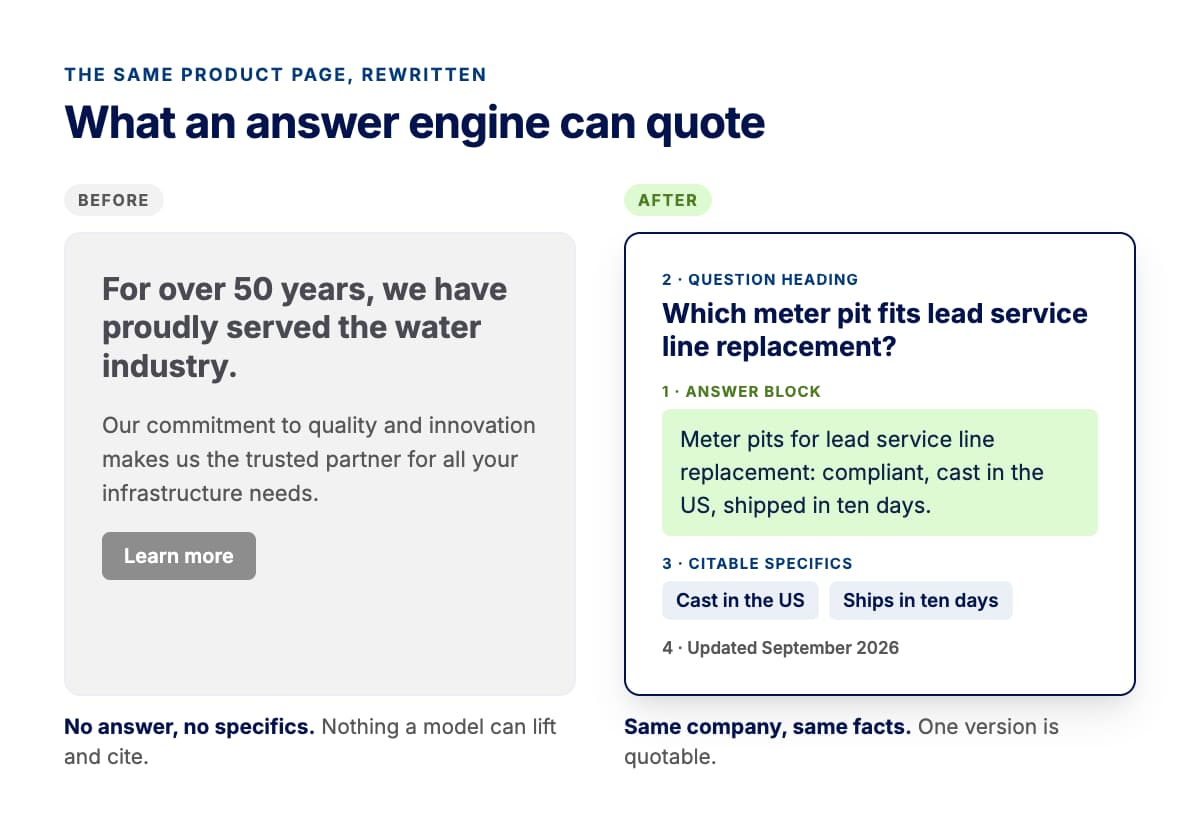
Here is the difference in practice. A product page that opens with "For over 50 years, we have proudly served the water industry" gives an answer engine nothing to quote. The same page opening with "Meter pits for lead service line replacement: compliant, cast in the US, shipped in ten days" gives the model something it can quote. Same company, same facts. One of them is quotable. We keep a working list of which pages to rewrite first for exactly this reason.
What this looked like for a manufacturer
Our client is a US manufacturer of utility access products. Their buyers are procurement managers and engineers who research compliance-driven components long before they contact anyone and in 2026 that research increasingly ends in an AI answer. We described their sector's version of this shift in AI search for manufacturers.
Since April 2026, the program's SEO work has run toward answer engine optimization: direct-answer structure on product and resource pages, question-form headings matched to real procurement queries and content built around the compliance questions buyers actually ask. The page work behind it was unglamorous, the kind of readiness work we outline for AI search: openings restructured to answer the compliance question in the first lines, resources built around the queries procurement teams actually type.
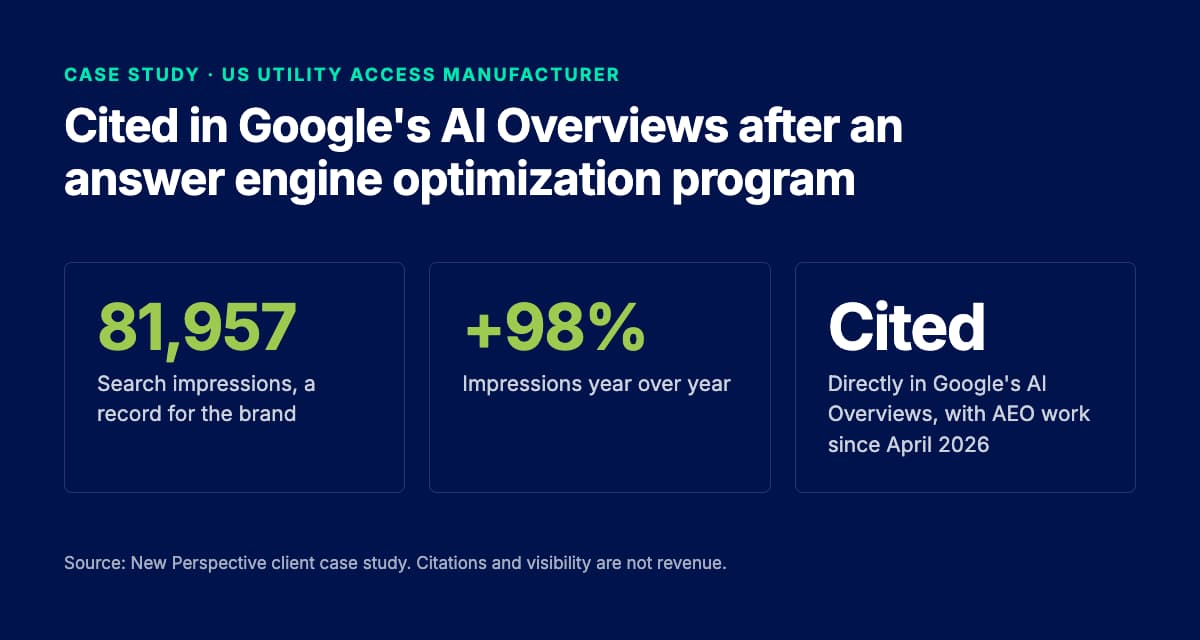
The published result: the brand earned direct citations in Google's AI Overviews and search visibility hit a record 81,957 impressions, up 98% year over year. We will be plain about what that proves and what it doesn't, the same way the case study is. Citations and visibility are not revenue and nobody can promise a model will cite you; anyone who guarantees citations is guessing about a system they don't control. What it demonstrates is the mechanism: a mid-size industrial brand, not a household name, became a cited source in its category when its content was structured to be quoted.
How do you measure LLM SEO?
Four signals in the order we check them.
Impressions and clicks diverging. Impressions holding or rising while clicks flatten usually means you are appearing in AI-answered queries. That is context for your traffic reports and the reason click counts alone now under-describe visibility.
Citations themselves. Pick the queries that matter to your pipeline and record, monthly: the query, the engine, whether you appear, which page gets cited and the wording the answer uses. Tooling for this is young; a disciplined spreadsheet beats no tracking.
Branded search and direct entries. Buyers who meet you in an AI answer often come back later by name. A branded-search lift alongside citation gains is the pattern we watch for.
Pipeline, eventually. A citation without pipeline movement is trivia. We connect this work to qualified pipeline the same way we connect every channel: source tracking on conversion paths and honest attribution about what influenced, not just what closed last.
What to do this quarter
Three changes cover most of the ground and none of them needs new tooling or a budget line.
First, rewrite the openings of your ten most important pages as direct answers. Ten pages, under 60 words each, the claim first and the support after. This is the highest-return hour-per-page work we know of right now.
Second, baseline the 20 queries that matter to your pipeline: record what AI answers currently say about your category and whether you appear. You cannot manage visibility you have never looked at and the baseline is what makes every later claim of progress honest.
Third, fix one corroboration gap. Find the directory, association page or partner listing that describes your company wrongly or not at all, and correct it. Models reconcile sources; make yours agree with each other.
If your impressions are climbing while clicks flatten and nobody can tell you whether AI answers mention your brand, book a Growth Marketing Session. We will pull what AI search currently shows for your product categories and walk through where your demand is going.