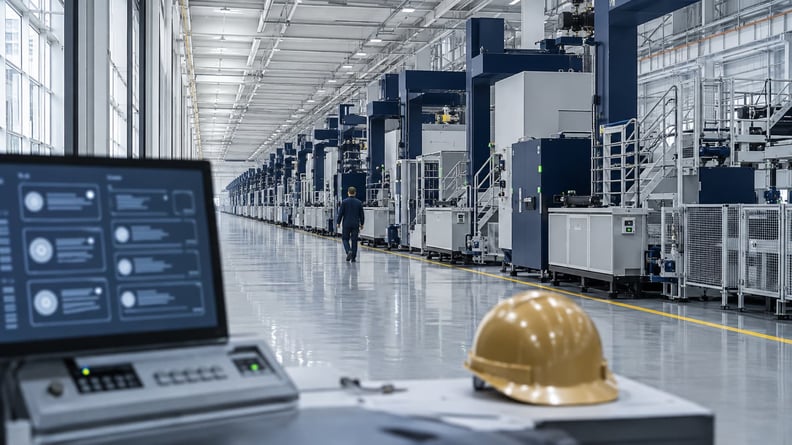

Manufacturing lead generation today means building a system that finds the buyers already researching your product category, captures their interest with content and conversion paths built for engineers and procurement teams, then routes every inquiry to the right rep before a competitor calls back. It supports a thinning field team rather than replacing it.
That last part is the situation most industrial marketers are actually in. The products are strong, the reputation is real and growth still depends almost entirely on personal coverage, at exactly the moment that coverage is getting harder to maintain. This post lays out the five-part manufacturing marketing system we build for companies in that position, with results from a client running all five parts.
Why manufacturing lead generation broke
The old model was coherent. Reps and distributors carried the relationships, trade shows generated the meetings and the catalog did the explaining. Marketing supported sales and nobody expected it to produce pipeline on its own.
Two things changed underneath it. First, the buyer moved online and now mostly stays there. In Gartner's survey of 646 B2B buyers, published March 2026, 67% said they prefer a rep-free experience and 45% reported using AI during a recent purchase. By the time a rep hears about a project, a shortlist often exists, built from search results and, increasingly, AI-generated answers.
Second, the buying committee grew. Forrester's 2026 buyer research puts the typical buying decision at 13 internal stakeholders plus nine external influencers. Most of that committee forms its opinion from research your reps never see.
Meanwhile the field side is not growing to compensate. Federal projections show wholesale and manufacturing sales rep headcount essentially flat through 2035, while the Manufacturing Institute and Deloitte estimate that as many as 1.9 million manufacturing jobs could go unfilled by 2033 if talent gaps persist. Coverage does not collapse. It thins, one retirement and one consolidated territory at a time. A model built on personal coverage degrades quietly.
That is where growth leaks. Buyers are actively looking during a 6-to-18-month evaluation, and nobody is systematically there to be found, to capture the interest or to route it to the right person.
Capture the demand that exists before building new demand
We separate two jobs that usually get blurred together. Demand capture converts the buyers already searching for what you make: specification-stage searches, compliance questions, product category queries. Demand generation builds awareness with buyers who are not looking yet.
For most manufacturers, capture comes first. The search demand already exists, it is cheaper to convert than to create and it produces evidence quickly. Generation matters, but it compounds slowly and it works better once the capture system proves which segments and regions respond. We wrote about what that looks like in practice in our review of what's working in industrial demand generation right now.
The distinction is concrete. Capture looks like winning the search for a compliant valve box in a state your reps rarely visit. Generation looks like the market knowing your name before the mandate that drives that search even lands.
What does a manufacturing lead generation system include?
Five parts, each with a specific job. The client running all five is a US manufacturer of American-made utility access products: curb boxes, valve boxes and meter access products. They sell through distributors and rep groups and their buyers are the engineers and procurement managers described above. Their published numbers appear where relevant and the full program is in our manufacturing lead generation case study.
1. Search visibility, including AI answers
Buyers who research certified components start with search, so the system starts with being findable for specification-stage queries: product categories, applications and the problem states that precede a purchase. The demand behind those queries is often regulatory. The EPA's final Lead and Copper Rule Improvements require water systems to replace lead service lines within 10 years, with up to 9 million homes still served through legacy lead pipes and $15 billion in dedicated federal funding. Layer on Build America, Buy America requirements for federally assisted projects and thousands of engineers are typing a compliance term plus a product category into a search box.
Increasingly, what they get back is an AI answer. Pew Research found users click a traditional result on just 8% of visits when an AI summary appears, versus 15% without one and Semrush's 2025 tracking shows AI Overviews moving well beyond informational queries into commercial ones. Being findable now includes being cited inside the answer. When we pivoted the client's search work toward answer engine optimization, the brand earned direct citations in Google's AI Overviews and visibility hit a record 81,957 impressions, up 98% year over year. We cover the how in AI search for manufacturers.
2. Content that answers procurement questions
Industrial content earns its keep by answering the questions evaluators actually ask: compliance requirements, material specifications, replacement mandates, installation constraints. Content aimed at those questions does two jobs at once. It ranks for the searches and it arms the internal champion who has to justify a selection to finance.
The client's version targeted lead service line replacement and Build America, Buy America compliance, the exact mandates pushing utilities toward domestically manufactured products. The case study reports readers spending an average of about 5.5 minutes on those pieces. Engineers do not give filler five and a half minutes.
3. Paid search where field coverage is thinnest
Paid search is the fastest lever and geography makes it strategic for manufacturers. Aim paid search campaigns at the regions where rep coverage is weakest, so marketing carries the territories sales cannot. For this client, geo-targeted Google Ads went live in December 2025 in two states and the performance data justified expanding to seven. That is what marketing where the field team is thinnest looks like in practice.
4. Routing and lifecycle in the CRM
Capturing interest means nothing if the inquiry sits in a shared inbox. The original lead response research from MIT and InsideSales.com found the odds of even contacting a lead drop 100-fold between a 5-minute and a 30-minute response. The study is from 2007; the inboxes it describes have not improved much since.
So every form carries product context and source tracking into the CRM and routing rules send each catalog or quote request to the right rep group by territory automatically. The client's system now moves 6 to 8 catalog and quote requests per day to the right desk, with nobody wondering which product line or campaign produced them. Routing is also where lead quality gets decided: context and speed, not volume, are what make sales trust the leads.
5. Measurement that reaches order data
We will say this the way we say it to clients: attribution on an 18-month industrial sale is never clean and anyone promising otherwise is guessing. What the system can show is marketing's contribution: first-touch source on every inquiry, engagement during the evaluation and, where the client shares order data, whether demand is moving in the regions and product lines the program targets.
For this client, the published picture was 24.6% sales growth year over year in a market the client described as relatively flat, with order value up 26% and units up 52% while order count held flat. The case study is careful to claim contribution, not sole cause, and so are we. Order value rose while the traditional growth lever, field coverage, thinned. That pattern is what a working system looks like from the outside.
Trade shows and digital are one system
The most common objection we hear is some version of "we need trade show support, not digital marketing." It is a false choice. The manufacturers who win at trade shows are the ones whose prospects already found them online, read something useful and formed an opinion before walking the floor.
Point the system at the show calendar. Capture campaigns warm the regions a show serves, content gives reps something worth sending in follow-up and CRM routing gives badge scans the same treatment as website inquiries. The booth gets more productive because the digital system exists, not in spite of it.
Where to start when marketing is one person
Most of the manufacturers we work with do not have a marketing department. They have a marketing person, sometimes half of one. The system still works, sequenced honestly.
Start with routing and forms, because losing captured demand is the most expensive failure and the cheapest fix. Add paid search in one or two weak-coverage regions next, because it produces evidence in weeks. Then build AI and search visibility and content on what the paid data proves buyers want. Measurement grows alongside each step rather than waiting for a grand launch.
A first 90 days usually looks like this: weeks one to four on forms, routing and source tracking; weeks four to eight standing up paid search in the two weakest territories; weeks eight to twelve building the first content around the questions the search terms reveal. Every step produces something the next step uses.
Whether the work is done internally or with a partner, what the system needs from that one marketer is context and approvals, not execution capacity. Reducing the load on that person is the point.
If your field team is smaller than it was a year ago and your quote requests still arrive with no product context attached, book a Growth Marketing Session. Bring your regions and your show calendar and we will show you where your demand is leaking and which part of the system to build first.