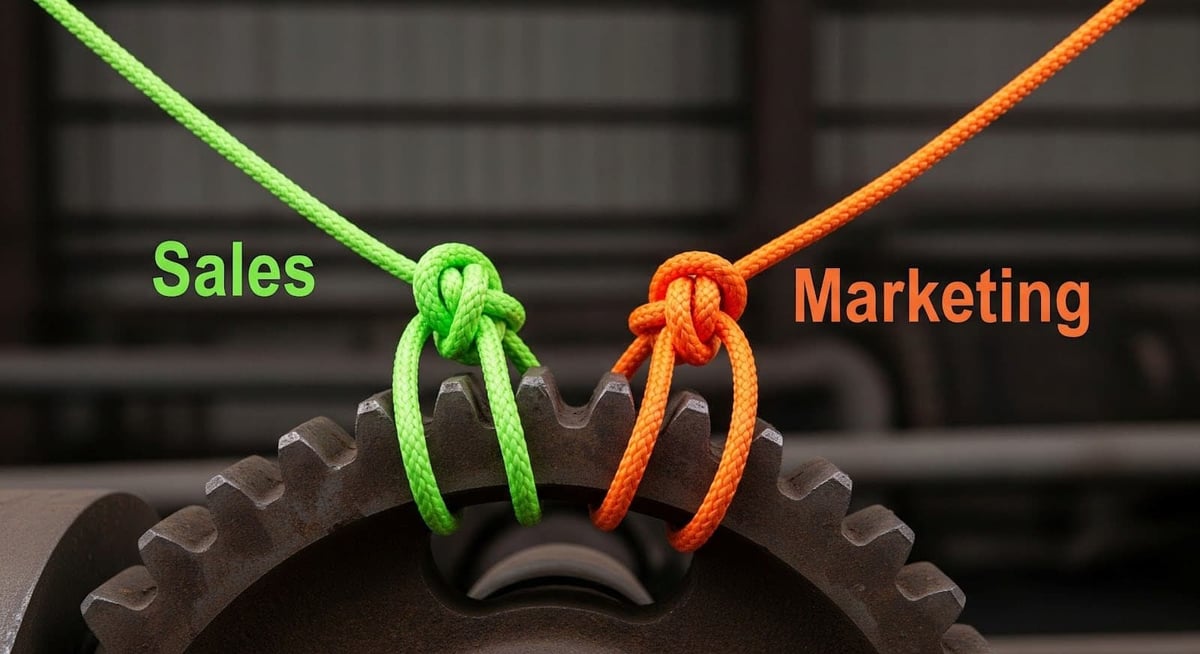
Growth stalls when ICP, messaging, handoffs, and metrics aren’t aligned, not because you’re “on the wrong channels.”
The Short Version: Stop Chasing Channels, Start Aligning
- Channels are not the root cause. Misalignment across ICP, messaging, handoffs, and metrics is.
- Use the five gear alignment model below to shorten sales cycles and raise win rates in industrial markets.
- If this matches your situation, consider a short Industrial Growth Alignment Workshop to reset your plan in days, not quarters.
When Leads Look Fine but Revenue Doesn’t
You optimized paid. You improved SEO and content. You tightened targeting. Pipeline quality still swings month to month.
Opportunities stall during technical validation. Sales says leads are not deal-ready. Marketing says sales are slow to follow up. Leadership asks for ROI.
In niche industrial markets with long buying cycles, the weak link is usually the alignment process.
Who you target, what you say, how you hand off, and what you measure must line up. If they do not, good campaigns underperform. Budgets get cut. Teams get frustrated.
Where Revenue Leaks Happen in Industrial GTM
- ICP drift: Your best customers share patterns, but campaigns chase every adjacent vertical.
- Message mismatch: Content gets engagement, but few contacts convert to a sales motion. Content answers what. Buyers need how and proof.
- Leaky handoffs: MQL, SQL, and opportunity definitions vary by team. Lead status uses free text.
- Buying group gaps: Technical evaluators and operators lack enablement. Only the economic buyer hears your value.
- Forecast swings: Deals may fall through at the last minute because the associated risk criteria were not correctly identified or evaluated.
- Attribution fights: Ops cannot map activity to revenue stages. Leadership cannot fund with confidence.
If three or more feel familiar, fix alignment before adding new channels.
Five Points of Alignment That Move Revenue
When these five areas work together, growth compounds. If one binds, progress slows.
1) Precision ICP: Who Buys Now (and Why)
- Define the exact accounts and personas most likely to buy now.
- Map pains by role. Operations, Engineering, EHS, Finance, and IT care about different outcomes.
- Tier accounts into one-to-one, one-to-few, and one-to-many. Match effort with value.
2) Claims Don’t Close; Evidence Does
- Anchor messaging to operational pains like downtime, yield, compliance, and safety. Tie to outcomes like throughput, opex, and risk.
- Pair each claim with a proof asset. Use case data, calculators, spec sheets, or third-party validation.
- Build a content spine for each persona across awareness, validation, and consensus.
3) One Process, Locked Definitions, Clean Handoffs
- Standardize lifecycle stages in HubSpot. Lock definitions. Automate status changes.
- Document entry and exit criteria for MQL, SQL, SAL, and opportunity.
- Use a single meeting to move to the next step in the playbook. Include a discovery checklist, a technical validation plan, and a mutual close plan.
4) Equip the Buying Team, Not Just the Economic Buyer
- Choose plays by tier. Executive alignment for Tier 1. Solution workshop for Tier 2. Programmatic nurture for Tier 3.
- Build role-based enablement. Use email sequences, talk tracks, objection handlers, and spec comparison sheets.
- Align SDR, AE, and SE roles to stages, no ambiguity on who does what and when.
5) Attribution That Funds What Works
- Instrument stage conversion, velocity, and win rate are the primary scorecard metrics.
- Configure attribution to answer two questions. What created opportunities? What helped close them?
- Review weekly. Fund the work that moves the stage conversion and cycle time.
The 90-Day Alignment Outcome
- A clear ICP with buying group roles, pains, and success metrics.
- One page that shows your go-to-market spine. Tiers, plays, handoffs, and definitions.
- Three proof-first campaigns are live, tied to key moments in the buying process.
- HubSpot lifecycle and deal stages standardized, with automation in place.
- A scorecard everyone trusts. Stage conversion, velocity, win rate, and CAC payback.
If this sounds like you, you do not need a six-month project. You need a focused reset.
Industrial Growth Alignment Workshop
Ready to tie your marketing activity directly to pipeline and revenue? We are launching a working 45-minute session that unites marketing, sales, and leadership. The goal is simple. Rebuild your go-to-market spine for industrial buyers.
The Workshop Outcome:
- Insights on where RFQs and revenue opportunities are being lost or slowed.
- 3 practical, growth-focused quick wins you can implement within 30 days.
- An executive-ready RFQ Readiness Scorecard benchmarking your process.
- You'll walk away with immediate clarity and a practical path forward.
Slow RFQs. Stalled deals. Marketing that’s busy but not building revenue. Let’s fix that. Book the free Industrial Growth Alignment Workshop and start proving ROI today.