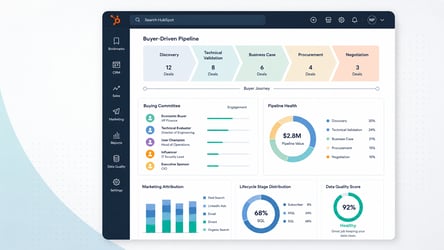
Most industrial marketing is built for one person. The engineer who fills in the form. The procurement contact who replies to the outreach email. The plant manager who shows up to the demo.
That person is real. They matter. But they are not the decision.
6sense's buyer research puts the typical internal buying group at ten to eleven people. Forrester's 2026 data adds thirteen internal stakeholders and nine external influencers on top of that. And almost all of that group's work happens before a vendor is ever contacted.
So if your marketing is built around the person who fills in the form, you are influencing the end of the process and calling it the beginning.
Who Is Actually Making This Decision
The buying committee in industrial manufacturing is not a generic B2B committee with the logos swapped out. It has specific roles, specific concerns, and specific reasons to veto a deal that never gets written down anywhere.
Engineering and technical evaluators usually get there first. These are the engineers, technical managers, and quality professionals who assess whether what you offer actually works. Their questions are concrete: Does it meet our specs? What certifications does it carry? How does it behave in our specific application? What does the integration look like?
Abstract brand messaging does not reach this audience. It raises their suspicion. GlobalSpec and TREW's 2026 State of Marketing to Engineers found that technical buyers rely on vendor websites and industry publications for independent research. They are already looking. The question is whether your content is worth finding.
Procurement and supply chain come in once the technical shortlist exists. They care about cost, contract terms, total cost of ownership, and whether you will still be a viable partner when something goes wrong three years from now. One failed supplier relationship does not just increase costs; it creates delays, quality problems, and supply risks that trace back to whoever signed off on the vendor selection.
Operations and end users are the most underserved audience in most industrial marketing. These are the production managers, plant floor teams, and maintenance staff who live with the purchase after everyone else has moved on. They want to know about implementation burden, downtime risk, training requirements, and what happens when something breaks. If your content never addresses any of that, this group fills the gap on its own. That is rarely favorable.
Executive sponsors hold budget authority and ask entirely different questions. A VP, plant manager, CFO, or GM wants to know about strategic fit, ROI, and long-term vendor viability. RH Blake's manufacturing buyer study found that 78% of buyers say the C-suite is highly or extremely influential in complex purchase decisions. The concerns that land with this group are reliability, total cost of ownership, and the credibility of your support model.
A technically strong evaluation that cannot survive an executive-value screen does not close.
One more thing worth knowing: committee composition shifts by purchase type. A straight rebuy is mostly a procurement conversation. A modified rebuy pulls in procurement and technical staff together. A new-task purchase, which carries the most risk and the longest evaluation cycle, requires all of the above. Not every opportunity requires the same level of campaign depth. The question is whether your current content structure makes any distinction at all.
Why Single-Persona Marketing Does Not Just Miss People - It Loses Deals
This is not a coverage gap. It is a consensus problem. Those are different things.
Gartner's 2025 sales research found that 74% of B2B buyer teams show unhealthy conflict during the decision-making process. Groups that reach genuine consensus are 2.5 times more likely to describe the deal as high-quality.
Here is where it gets sharper: content tailored to buying-group relevance improves consensus by 20%. Content focused solely on individual-level relevance can have a 59% negative impact on consensus.
That means if you are only producing content for one stakeholder, you are not just missing the others. You are actively making it harder for the committee to agree.
The timing problem compounds it. Research across multiple 2026 B2B benchmarks consistently shows that buyers establish most of their purchase requirements before speaking with a seller. 6sense's data is more specific: 81% of buyers already have a preferred vendor at first contact, and 95% of purchases came from the vendor on the day-one shortlist.
The committee is doing its most important work, defining the problem, comparing approaches, and building internal consensus before sales are involved. If your marketing reaches only one person through a single channel, you are not shaping that process. You are showing up after it has already happened.
Research from Corporate Visions describes modern B2B decisions as less like a structured committee vote and more like a loose network of influencers. That tracks in manufacturing. Engineers share spec sheets informally. Plant managers weigh in before they are officially part of the process. CFOs ask procurement for a recommendation, then take it straight to a budget decision.
The structure is messier than a flowchart suggests. Which means the coverage problem is also messier than most marketing teams account for.
What Committee-Aware Content Actually Looks Like
The goal is not more content. It is content that travels through the committee and helps people at different levels make the same case to each other.
For engineering and technical evaluators: depth is the value. Specification pages, application-specific white papers, integration documentation, quality and certification proof, and a video that shows the product in actual use. GlobalSpec and TREW found that how-to tutorials and installation guides rank highest among the video formats technical buyers watch, ahead of whiteboard deep dives and product demos. Short brand videos do not reach this audience. Content that teaches them something does.
For operations and end users: the job is reducing implementation anxiety. What does rollout look like? How much disruption is involved? What does support look like after go-live? What do maintenance cycles require? If your website and your sales process cannot answer these questions before they surface, this group raises them as objections at the worst possible moment. Usually, the night before a vendor decision.
For procurement, finance, and executive approvers: make the business case on their terms. Total cost of ownership models, customer references from comparable manufacturers, supplier-stability information, and executive summaries that do not require engineering fluency to parse. RH Blake's manufacturing buyer study found that direct proof and usable information outperform case studies in terms of credibility with this group. They are not looking for inspiration. They are looking for justification they can bring to someone above them. Give them the assets that make that conversation easier.
Channel mix matters here, too. CMI's manufacturing benchmark data shows that search and PPC deliver the strongest paid results for manufacturing marketers, that LinkedIn is the most valuable social platform, and that case studies, white papers, and videos rank among the most effective content types. McKinsey's and Martial’s Group B2B research shows that buyers use an average of 10 channels across a purchase journey. That argues for coordination across technical SEO, trade publications, LinkedIn, webinars, email, and application-engineering follow-up. Not a single-channel campaign with one buyer in mind.
For more on what content actually drives qualified leads from industrial buyers, see our post on higher lead quality for manufacturers.
Making It Operational
The committee-aware version of ABM is not about personalizing a few LinkedIn ads to a named account. It is about identifying the buying group, mapping the roles, and coordinating marketing and sales so the committee sees a coherent case from multiple directions at once.
Forrester's demand and ABM guidance frames it clearly: the job is to respond to digital signals, support buying-group members, and run programs designed to detect and enable the full group, not just generate individual form fills.
The numbers behind this are worth taking seriously. Demandbase's 2026 benchmark analysis of over 1,400 organizations found that teams aligned around buying groups achieved two to three times higher win rates compared to lead-centric teams. A typical buying group in their data included thirteen to seventeen stakeholders. Most mid-market industrial marketers are still measuring this problem at the individual-lead level.
What changes operationally: replace lead-volume dashboards with committee-coverage questions. How many relevant roles in this target account have engaged with our content? Have both technical and economic stakeholders been reached? Are sales and marketing using the same value narrative when they reach different parts of the committee?
That last one is not academic. Gartner found that 69% of buyers experience inconsistencies between what the website says and what the seller says. That inconsistency alone creates doubt in a committee already trying to reach consensus across competing internal pressures.
This is the shift that makes industrial marketing actually work: from campaigns designed to generate individual leads, to programs designed to build buying-group agreement. It is harder to build. It also produces a pipeline that actually closes.
To see how we approach industrial and manufacturing marketing when the product is complex, and the sales cycle is long, or how we structure account-based marketing for manufacturers and industrial firms, both pages are worth your time.
Start With This Audit Question
Take the last five pieces of content your team published. For each one: which committee role was this written for? What stage of the buying process does it serve? Could a procurement lead use this to build an internal case? Could an operations manager read this and understand what implementation looks like?
If the honest answer to most of those questions is "we wrote it for the person who first contacts us," you have the diagnosis.
The problem is rarely a lack of content. It is content built for one person at one stage, in a process where 10 to 13 people need to reach an agreement.
If your team is working through this, we are worth talking to.

Resources